Learning Outcomes
i. Identify hinge joints and their locations in the human body.
ii. Describe the structural characteristics of hinge joints.
iii. Understand the types of movements hinge joints allow and their role in daily activities.
i. Identification and Location of Hinge Joints
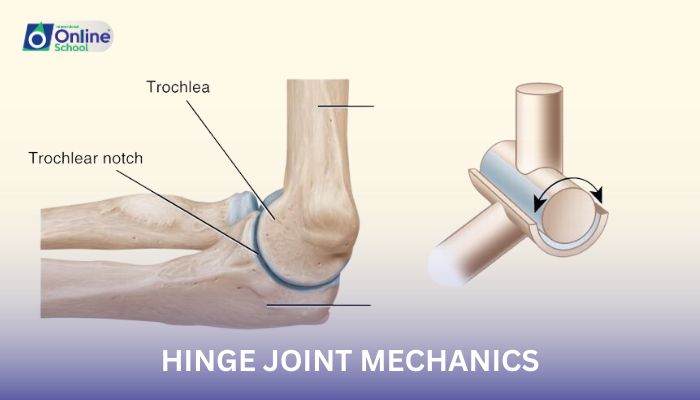
Definition: Hinge joints are a type of synovial joint that permit movement in one plane, much like the opening and closing of a door.
Location: Common hinge joints include the elbow, which connects the humerus with the radius and ulna, and the knee, which connects the femur with the tibia.
ii. Structure of Hinge Joints
Bones: Hinge joints involve the articulation of two or more bones where the convex end of one bone fits into the concave end of another.
Ligaments: They are stabilized by ligaments that prevent lateral movement and ensure that the motion is limited to one plane.
Synovial Membrane: These joints are enclosed by a capsule lined with a synovial membrane, which secretes synovial fluid for lubrication.
iii. Movements Allowed by Hinge Joints
Flexion and Extension: Hinge joints allow for flexion, a bending movement that decreases the angle between the articulating bones, and extension, a straightening movement that increases the angle between the bones.
Role in Activities: These movements are essential for numerous daily activities such as walking, writing, and lifting objects.
In conclusion, hinge joints are a specialized type of joint that allow for a significant range of motion in one plane. They are crucial for the performance of many everyday activities that require flexion and extension movements. The structural design of hinge joints, including supportive ligaments and lubricating synovial fluid, ensures their functionality and durability under various mechanical stresses. Understanding the mechanics of hinge joints is fundamental to fields such as biomechanics, physical therapy, and sports science.
